When Practice Builds Concepts
Reflections on the concepts organisations are building from practice, and what naming them makes possible

This Quarter in Brief
Between July and October 2026, the Centres for Exchange (CfE) network completed its mid-term round of reflection. The sense-making workshops that kicked off with Praxis in May came to a close, with ATREE and INR holding theirs in July, and SEARCH and Sonke in August. Each workshop gave partner organisations and their key stakeholders space to look back at what they had learned so far, and to consider what to adapt in the second half of the project.
In September, all eight organisations came together online for a four-part cross-project adaptive learning workshop. Each project team presented the main lessons from their own sense-making, and then tested those lessons against the CfE Learning Framework’s three domains (Knowledge Creation, Institutional and Ecosystem-Level Transformation, and Knowledge Exchange).
This issue draws on both the mid-term sense-making workshops and the cross-project workshop.
What We're Learning
Across the Centres for Exchange (CfE) programme, partner organisations are evolving participatory methods as they put them into practice. This is what “learning through practice” looks like in adaptive learning projects: insights from practice generate a concept and then the concept reshapes the practice.
Naming what is learned turns out to be part of the work. A name captures ideas, experiences and learning, and makes visible aspects of the work that otherwise feel intangible, such as relationships, trust, judgement, and power. Once something has a name, it can be planned for, budgeted and carried into tools and systems. Naming is also a mode of categorising, though, and categories can also exclude. They can leave things out, and can stigmatise as easily as they recognise.
Each insight below examines one component of research practice that funded organisations have been rethinking through CfE, across diverse contexts, and at the new concepts emerging as a result.
From participating in research to participating in knowledge
In traditional research structures, communities tend to be positioned as holders of information or data, while the role of knowledge maker sits with researchers. Community members share their experiences, answers and stories, but meaning is made elsewhere, by researchers who analyse these forms of knowledge as "data" (deciding what should be included, how it should be interpreted, and what is, or is not, important). This structuring of authority over knowledge can also carry into participatory research. Communities may participate deeply in some aspects of the project, while the authority to define knowledge stays with researchers. As Shujaaz notes, "participation in research is not the same as participation in knowledge."
Across CfE, funded organisations are making space for communities to hold more authority over knowledge, shaping what is asked, how it is interpreted, and how it is shared. In doing so, they are challenging three connected assumptions: who holds expertise, who has the authority to interpret data, and how knowledge is held and shared. We interrogate each of these assumptions below, drawing out the concepts that funded organisations are developing to name and explain what they are doing differently to challenge these assumptions.
Who holds expertise
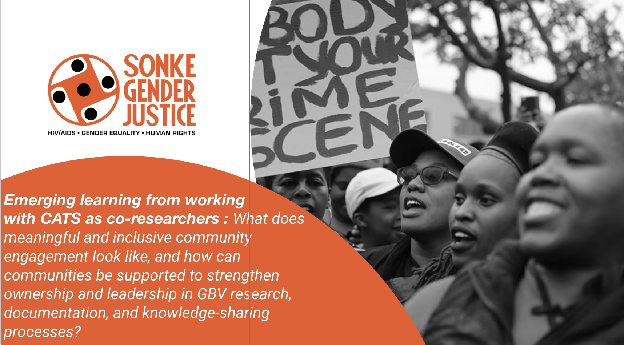
Through WaCurious, its youth-led research model, Shujaaz found that the young researchers they work with shape "the questions and language" of the research, not just the data produced. Shujaaz is clear that the value of their involvement is "not only proximity to participants" but also lived experience expertise, relational authority, and both language and contextual understanding. Communities, they have found, bring what they are framing as “hyperlocality”: knowing what is "ordinary, unusual or sensitive in ways an outsider may not understand." Similarly, Sonke's Community Action Teams (CATs) bring an insider's view of community dynamics and norms. When the research team took that view seriously, it reshaped the research. As the team explained, "questions and processes shifted after CATs spoke." Sonke describes how recognising CATs as experts in their own right has resulted in researchers and CATs "learning together, rather than expertise flowing in one direction." One researcher noted that, as a result, the CATs now "feel capable of teaching us." CATs are now positioned in the project as co-researchers. In practice, this has meant building CATs’ capacity and confidence, and involving them in shaping research questions, in understanding the purpose, methods, and ethics of the research, and in adapting approaches to their communities. As Insight 3 shows, the role also carries costs that are not yet fully recognised or resourced.
SEARCH's podcast series takes up the same question of who teaches whom, exploring the question "what rural patients can teach a medical surgeon?" The series is designed to let historically marginalised rural communities reshape the perspectives of public health specialists.
Who interprets evidence
Issue 2 of the Bowl described how Lwala turned the sharing of its 2024 household survey results into community learning sessions. Since then, the team has been working to embed research more fully into community structures "to change who could participate in interpreting the evidence," by making evidence "something people could engage with and question." As they noted, a survey of more than 8,000 households could show patterns, but communities supplied the "why" behind them, and identified gaps the data did not show. Lwala now describes communities as active, critical interpreters of data, who make deeper meaning from the evidence.
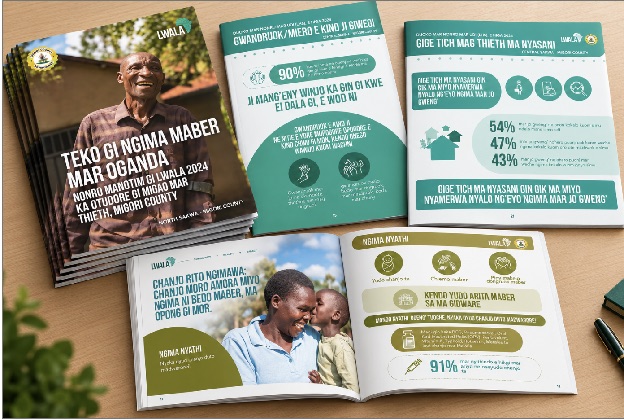
Lwala has found that when findings are shared only through a technical report or presentation, "community participation is naturally limited." Recognising the need for accessible approaches, the team has developed booklets in English and Dholuo that share survey findings through infographics and stories. In community sharing sessions, these resources were combined with facilitation tools such as problem trees and mapping, so that community members could identify and explain what lay behind the findings.
In whose terms knowledge is held and shared
The SEARCH team reflected that traditional research is still largely built for "academic publication, citations, and institutional prestige," and thus written in "dense, abstract, jargon-heavy reports" addressed to "elite scientific peers and traditional funders." This raises the question of who meaning is being made for and, therefore, in what form knowledge should be shared.
The SEARCH project team engaged with this question in translating Dr Rani Bang's book Goeen, on tribal women's botanical and maternal health knowledge. The team saw that a mechanical, “scientific” translation would reduce medicinal trees to pharmacological compounds and erase the worldview behind them, SEARCH instead treated translation as cultural interpretation. Concepts that literal translation would distort were worked through in discussion, word choices were reviewed in editing because they shaped how key ideas would be understood, and local references were explained for new readers. The aim was to keep the folklore, ritual songs and ecological relationships that hold the full richness and meaning of the book. The team reflected, "If you strip away the metaphor to make it sound ‘scientific’, you destroy the knowledge itself."
Across these examples, funded organisations are building a vocabulary for community authority over knowledge: hyperlocality, the insider’s view, co-researchers, interpreters, and cultural interpretation. The final section looks at what these names are changing in practice, and what they leave unsettled.
Rethinking rigour
In traditional research, rigour means standardised procedure, methodological precision, distance from the subject, and sharing findings through academic formats. Funders, ethics committees, and journals tend to judge rigour by the standards of this particular kind of research. Participatory research has long questioned these norms. Yet measured against them, it can appear less rigorous than it is. As the Shujaaz team has observed under these “institutional standards and definitions of rigour,” the two forms of knowledge do not meet as equals”. Across CfE, partner organisations are rethinking rigour in three ways: in how research is done, in the researcher's stance, and in how knowledge is shared. Their examples suggest that engagement can strengthen rigour as conventionally understood, for instance by testing findings against community reality, while also widening what rigour covers.
Engagement as a form of rigour
In Shujaaz’s WaCurious project, young researchers’ local knowledge is paired with training, consent and ethics, questionnaire testing, geo-verification, quality checks, field support and data review. As Shujaaz has argued, “community-led does not mean less rigorous,” rather, “rigour comes from combining lived knowledge with research structure.” Lwala builds deeper rigour through community validation of research findings. Research becomes more rigorous because communities check whether the evidence matches their reality, extending the interpretive role described in Insight 1. In both cases, engagement is part of what makes the research rigorous.
Humility as a form of rigour
Discussions at the September workshop also identified humility as an important form of rigour in participatory research, achieved through stepping back, listening, and questioning assumptions about who counts as an expert. For SEARCH, this draws on the Gandhian principle of “absolute humility” in research, which begins by setting aside any assumption that the researcher’s knowledge is superior. The Goeen translation described in Insight 1 shows this in practice. In translating the book, SEARCH declined to reduce the knowledge of tribal women and traditional birth attendants to pharmacology, and treated it as knowledge in its own right. Here, humility made the translation more accurate, keeping meaning that a “scientific” rendering would have lost.
For us this raises the concept of epistemic humility: the recognition that any researcher’s knowledge is partial and shaped by where they stand, and that others may see what they cannot. Traditional scientific rigour manages the researcher’s influence through distance from the subject, but distance can also hide a researcher’s standpoint without removing it (a central argument of feminist standpoint theory). Epistemic humility produces research rigour by listening to people who know the context, and being ready to be corrected by them. Understood this way, humility guards against error, which is what rigour is for.
Simplification as a form of rigour
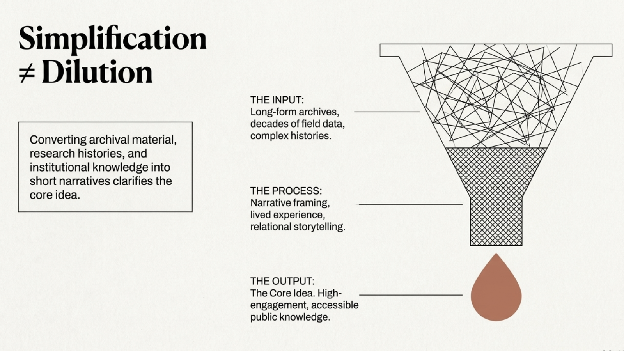
Issue 3 described SEARCH’s finding that turning archives, research histories and institutional knowledge into short narratives “clarifies the core idea” while keeping its depth. SEARCH now names this as a principle: simplification is not dilution. It challenges the assumption that making knowledge accessible means losing something, or producing something less rigorous or valuable. Distilling decades of material into a short story requires being clear about what matters most. The accessible version becomes a new form of knowledge in its own right.
Naming engagement, humility, and simplification as forms of rigour makes visible the rigour already present in CfE organisations’ practice, in terms others can recognise and value.
Research as integrated, relational, and ongoing
Research, both traditional and participatory, is usually organised project by project, largely because that is how it is funded. A team enters, builds relationships, sets up project-specific tools, systems and structures, and leaves when the project ends. Trust has to be rebuilt each time a project starts, and because the relationships belong to the project, they end when it does. Across CfE, funded organisations are finding that research often works better when it is integrated into existing structures, held in relationships, and ongoing.
Integrated: no parallel system
Lwala embedded research in structures communities already use and trust because it “deliberately did not want to create a parallel system for research engagement.” The project team therefore worked through the relationships, meetings, and platforms already used to plan and deliver health services. These included county and sub-county actors, chiefs, ward administrators and elders; community health workers and committees; barazas (formal or semi-formal community gatherings called by local leaders, administrators, or human rights groups); and churches, schools and local groups.
When research travelled through these channels, findings met the reality of communities and were more easily acted on. Lwala is now working to turn this from “a successful project approach to a repeatable organisational practice.”
Relational: who holds the relationship
Building on their project experience, Sonke has drawn attention to the invisible labour that community researchers carry when infrastructure is thin. In the project, the relational work that kept the research going was led by the CATs, happened outside data collection, and was “largely unbudgeted and unrecognised.” In areas where Sonke had no existing presence, “community entry demands more trust-building from CATs,” so the work took longer to get started. When implementation was delayed, CATs were left, in Sonke’s words, “facing communities with questions they could not yet answer,” and “their own trust and credibility was questioned, not Sonke’s.” As Sonke put it, “When a project stalls, the reputational cost is paid locally.” Community researchers like the CATs carry both the work of holding these relationships and the cost when a project falters, usually with the fewest resources and the least say over timelines.
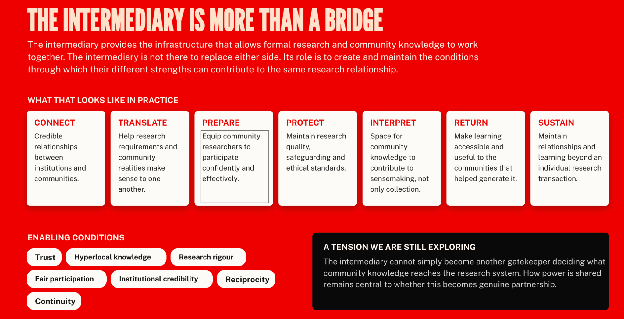
Looking closely at WaCurious, Shujaaz concluded that much of its value lies beyond training and deploying community researchers for a specific project. Instead, “its value sits in the relationships, systems and practices surrounding the research.” For Shujaaz, the hard part is: “to create the conditions in which different forms of expertise can genuinely work together.” This has led Shujaaz to rethink its role, from connecting researchers and communities to sustaining “the conditions through which their different strengths can contribute to the same research relationship” over time. Shujaaz calls this an intermediary capability: “A network gives you relationships. An intermediary capability is the organisational ability to activate those relationships repeatedly, ethically and credibly around a research purpose.” They describe the intermediary as “more than a bridge,” with seven functions: Connect, Translate, Prepare, Protect, Interpret, Return, Sustain. It is also clear about the risk: the intermediary “cannot simply become another gatekeeper deciding what community knowledge reaches the research system.”
Ongoing: relationships that outlast the project
In WaCurious, Shujaaz describes a different kind of research relationship: one that “does not begin when a questionnaire arrives, and does not need to be rebuilt from zero for every project,” and it “does not have to end when data collection does.”
Shujaaz’s Shape–Interpret–Return framing shows why this matters. It grew out of WaCurious fieldwork, where participants kept asking “so what?” They wanted to know what had happened to what they had shared. Shujaaz began to treat participation as something that runs through the whole knowledge cycle, from the first questions to what comes back to communities. The framing asks three questions. Shape: who decides which questions matter? Interpret: whose knowledge makes sense of the findings? Return: do communities “see what their contribution became, and get to respond”?
Return is the step most likely to fall away. Data cited by Shujaaz at its sense-making workshop found that 44.6% of young people with previous research experience had never received feedback on findings, a gap that can discourage future participation and make research feel extractive. In WaCurious, closing the loop means turning findings into Shujaaz-style stories and sharing them back through WhatsApp. But a cycle only closes if someone is still there to close it. Findings often take shape after fieldwork ends, sometimes after a project has closed, which led Shujaaz to ask, “what if knowledge exchange doesn’t stop when the research ends?” Answering that question takes relationships and infrastructure that outlast any single project.
Funded organisations turned the same question on CfE itself. At the September workshop, they noted that participatory research takes longer than project timelines and budgets allow, including CfE’s own, and asked what it would take to leave well when a project ends. WCCI, Lwala, SEARCH, and Praxis are each adapting their work so that it continues beyond CfE.
What naming makes possible
Across the three insights, concepts are emerging from funded organisations’ practice. Many of them, including hyperlocality, intermediary roles, co-researchers, and invisible labour, have histories in other fields and literatures. Organisations arrived at them through their own work, which grounds them in specific contexts and gives organisations language to connect their practice to those wider conversations. Naming makes visible work that is otherwise easy to miss, from communities interpreting evidence to the relational labour that keeps research going. Once that work is made visible, it can begin to be planned for and resourced. Naming is also a way of categorising, and categories can also exclude. Most of these concepts were named by organisations and selected for this issue by us, so it is worth asking whose language they are and who they leave out. A name can also arrive before the resources it implies. In Sonke’s case, CATs are now seen as co-researchers, while much of the relational work the role involves went unbudgeted in the project planning. What a name changes depends on what changes alongside it.
Questions We’re Sitting With
How can communities have more say in naming what they know and do, and in deciding which names travel into policy, funding, and research?
Much of what partners are learning is relational: trust, judgement, and the work of holding relationships. How can this kind of knowledge be documented and acted on without flattening it into categories that leave things out?
If research relationships are held by community researchers and intermediaries, what would it take for funders and institutions to resource them beyond the life of a single project, CfE included?
How can what organisations are learning be shared in forms that keep its depth, and reach the communities who helped produce it as well as funders and researchers?
Looking Ahead
Following the September workshop, projects are moving into their final stage of implementation. Some are still in fieldwork, while others are drawing their work to a close and deciding how best to share what they have learned.
Many of the questions partners have raised point towards funders: how rigour is judged, whether relational work is budgeted, and how long projects are given to run. These questions will carry into the next phase of learning, including a final convening of partners and Wellcome in India in 2027.