When Sharing Makes Knowledge
Reflections on how sharing is proving inseparable from how knowledge is made, drawn from project experiences across the network
This Quarter in Brief
The period between April and June 2026 has been marked by organisations settling into their implementation work and learning, and preparing for their mid-term sense-making workshops. Sense-making serves as a crucial moment for organisations, their communities, and other stakeholders to take a pause and reflect on their learning to date, allowing for space to consider adaptation as they head to the final stages of their projects. These workshops, which started in May, with Praxis leading the way, are now in full swing, with all organisations set to have completed their workshops by September. This issue pauses on a question that has been surfacing as projects share what they are learning: what if knowledge sharing is not what comes after research, but part of how knowledge is made?
What We're Learning
There is often a temptation in research and development programmes to treat knowledge sharing as what comes after the work. Findings are produced, then they are communicated. The research happens, then it is disseminated. Knowledge sharing, in this framing, becomes a question of who we share with (audience), how we share (format), and where we share (platform).
But the experiences emerging across CfE projects are telling a different story.
As partner organisations have moved deeper into implementation, knowledge sharing has revealed itself to be something more fundamental than a downstream activity. When communities and lived experience experts participate as co-producers of knowledge, the question of how that knowledge travels becomes inseparable from the question of what knowledge is worth producing in the first place.
This issue of The Bowl focuses on knowledge exchange, one of three learning domains in the CfE Learning Framework, the shared scaffolding that guides learning across the network. It asks what enables open, inclusive, and equitable knowledge exchange, and how learning and insight move across projects, communities, and contexts. This raises questions about which languages to write in, which platforms to use, and how to honour the boundaries of what people are willing to share. These questions can be challenging, because these choices are not neutral. They decide who is addressed and who is excluded, whose access counts, and who controls how far knowledge travels.
CfE is revealing that knowledge sharing is not just an external, communications function, separate from research activities. Rather, it is an integral part of how meaningful and inclusive research works. It requires care as much as craft, and building and holding spaces that are conducive to impactful knowledge sharing.
In the context of the CfE programme, knowledge sharing happens at various levels, between different stakeholders. The bulk of sharing activity is currently happening at the project level, with each organisation bringing stakeholders together, to build knowledge through sharing, and to communicate what they are learning in the context of CfE. At the network level, partner organisations are sharing as peers, supporting each other with expertise, ideas and resources. Sharing with the research ecosystem, through the CfE website for example, aims to influence the field to adopt or support more inclusive research practices. Ecosystem-level sharing will develop more fully as learning is consolidated and the long-term vision for the initiative is sharpened by these insights.
-
PROJECT-LEVEL
Place-based sharing
Community members, local stakeholders, internal and external audiences.
Led by: PoCsSupport: L&E team
-
NETWORK-LEVEL
Peer support spaces
Within the CfE partner network. Peer learning, sensemaking, and shared inquiry.
Led by: PoCsSupport: Network Facilitator team
-
PROGRAMME-LEVEL
Field-facing influence
Health research ecosystems, funders, policy actors, and the wider practice field.
Led by: L&E / WellcomeCo-implemented with: PoCs
Sharing through doing, and the relationships that make it possible
The Ashoka Trust for Research in Ecology and the Environment (ATREE), based in Karnataka, India and the Institute of Natural Resources (INR), based in KwaZulu-Natal, South Africa are working together on one CfE project, which centres questions of how to share knowledge and learning across contexts. At both sites, the teams are working with farming communities and rely on internal knowledge sharing between farmers and stakeholders as a first step. A deceptively simple insight has been emerging from the field: knowledge sharing happens most richly and effectively when people are working together on something.
ATREE has been conducting participatory research in tribal communities in the Karnataka state of India. In partnership with a local organisation, WASSAN, they have been exploring the impact of agricultural interventions on soil, yield, and farming practice. When the team engaged farmers in soil sampling, an activity typically governed by scientific protocols and conducted by researchers alone, farmers demonstrated that they were capable of far more than following the required protocols. When space was made for listening to their insights, they also enriched them. Participant farmers guided the researchers with their extensive local knowledge of the landscape, soil moisture, seasonal changes, and land-use history, providing important context for interpreting soil samples. The process became one of bidirectional learning, as the researchers were guided by the farmers towards richer findings, and the farmers were able to internalise the findings through experience. As Asmi Khushi from ATREE reflected: "Including people at this stage really helped to form the relationships which allowed a lot of knowledge sharing, as opposed to activities that were only dedicated to knowledge sharing."
But a cautionary counterpoint came from INR, working with their partner organisation, Mahlatini, recounting what happened when they brought together farmers from different sites, in KwaZulu-Natal, South Africa, for a day of shared learning, about similar practices. While their aim was to build a space for ongoing knowledge exchange, the farmers they brought together did not meet or share anything after the event. The reason, it turned out, was structural: the farmers who participated were individuals who had self-selected into a project, with no prior relationship to one another. The event had generated energy in the room, but with no relational substrate beneath it, nothing travelled.
The tension between these two experiences is the insight. “Doing together” generates sharing organically, but only where the conditions for genuine relationships already exist or are actively being built. Where those conditions are absent, where people are convened as a group but do not yet function as one, even well-designed sharing activities may not forge relationships. This raises a prior question that knowledge sharing planning rarely addresses. Before we design the exchange itself, we must ask: how do we identify people who can come together as a group to share knowledge? And how do we help build the relationships that make knowledge exchange meaningful?
Sharing is integral to (re)searching
The Banyan team, which is exploring how knowledge is co-created, transmitted, and adapted within mental health care settings for people with psychosocial disabilities and histories of homelessness, came to the June cross-project workshop, in which organisations share recent learning, with an admission that will resonate across the network: they were “drowning” in insights from their research knowledge sharing workshops.
In addition to observations from a five-day capacity building processes for carers in a new mental health facility site by a lived experience expert, the team had run six workshops with care providers, service users, and researchers working on care in homelessness and psychosocial disability contexts. The workshop topics ranged from bioethics and governance to cyanotype (photographic) art-making and storytelling.
Across all of these engagements, the project team found themselves holding a density of rich, relational, complex knowledge that resisted easy packaging. In these workshops it became evident that the very act of sharing produces some of the most meaningful knowledge in the project.
The cyanotype workshops offer the clearest illustration. Care providers, including frontline workers, social workers, and management staff, were invited to work with photographic printing techniques and natural materials to capture images of objects that represented care for them. What began as individual exercises became collective. Participants shared materials and helped one another arrange their pieces. In doing so they revealed something about how they understood and embodied care that no structured discussion had yet surfaced. The sharing process was not a record of the insight. It was where the insight happened.
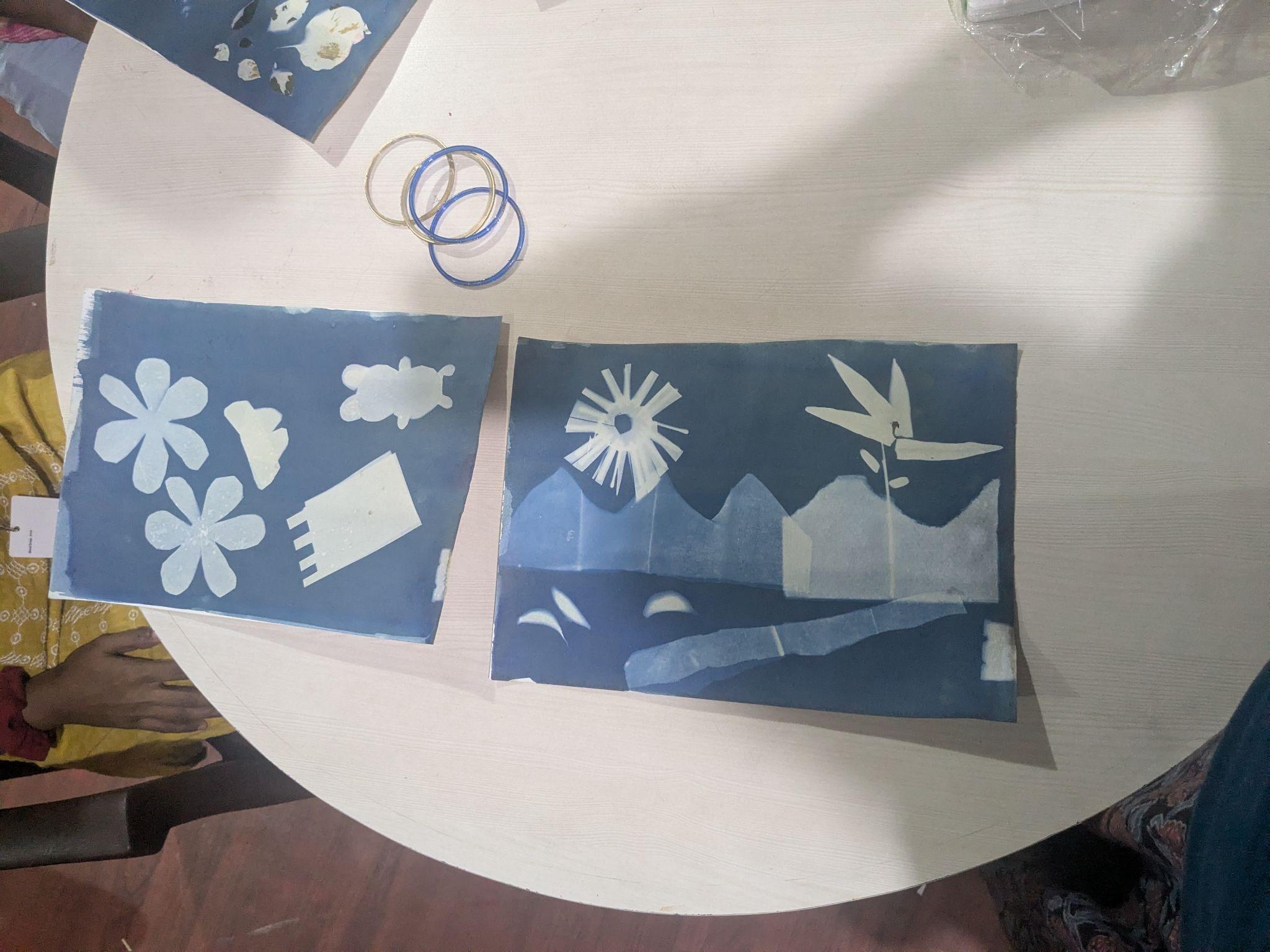
This is shaping how The Banyan is approaching knowledge sharing formats. Rather than asking "how do we communicate what we've learned," the team is asking "what forms allow learning to keep happening as it travels?" The answer is plural. A podcast is chosen over video because audio travels on limited bandwidth in ways video cannot. Alongside it: a lived experience zine (booklet), blogs, and, for scholarly audiences, academic writing on the temporal architecture of care. Each format reaches a different layer of the ecosystem.
The Banyan's workshops have also made visible how frontline and management care workers are routinely erased from narratives about care provision, their knowledge unrecognised, their labour uncounted. This is part of what the team’s careful approach to sharing is designed to counter: choosing forms of sharing that allow this knowledge to be recognised on its own terms, rather than flattening lived experience into single-faceted data.
Stories and lived experience are conducive ways to communicate research
As the projects find insights worth sharing, they are all faced with decisions about how that sharing should be done. This means asking what forms knowledge needs to take to travel - not just to reach people, but genuinely land with them.
For SEARCH, a community-based health research organisation in India with over four decades of experience, the answer has been emerging through close attention to what their communities respond to. SEARCH's CfE project has been exploring what it means to communicate research with people rather than at them.
Much of SEARCH’s work this quarter revolved around the question of how to communicate the organisation’s founding principle of Arogya Swaraj, or people's health in people's hands, to audiences beyond Gadchiroli in Maharashtra, where SEARCH is based. This inquiry is driven by one of their main learning questions: “How can we use storytelling to describe key components of a community research framework grounded in Gandhian principles?”
To answer this question, the team has been leading three complementary activities. The first is the translation of books written by SEARCH's founders Dr. Abhay and Dr. Rani Bang from Marathi into other languages. As Somita Pal from the SEARCH team put it, these books "deserved a wider audience because they contained lessons that go beyond Gadchiroli.They show how knowledge can emerge from communities, how listening can shape research, and how ordinary people can become active participants in solving health problems."
Secondly, the team has begun developing a documentary on SEARCH's forty-year journey, paying careful attention to finding film-makers who went beyond technical skills to demonstrate aligned values, contextual sensitivity, and a willingness to gain understanding by immersive engagement with the communities being represented.
And finally, SEARCH has been running a social media series called Research with the People that translates complex ideas from the organisation's institutional history into short, accessible stories. The social media analytics have confirmed what community experience had long suggested: just how profoundly people connect stories, songs, and real-life accounts. As the SEARCH team reflected: simplifying a message does not mean reducing its depth. Converting archival material, research histories, and long-form institutional knowledge into short narratives often clarifies the core idea, rather than diluting it. Audiences responded more strongly to stories grounded in real experience than to abstract descriptions.
The choice to lead with stories and lived experience is about more than making research more accessible, a theme we began exploring in our first edition of The Bowl. It is also about recognising what forms of knowledge are most useful, most grounded, most likely to be felt, and most capable of prompting action. Through the CfE programme, partner organisations have created space to take that seriously, asking what it would mean to design knowledge sharing processes that centre those forms of knowledge.
Sharing is the work, not the afterthought
Across three very different contexts, farming communities in Karnataka and KwaZulu-Natal, mental health care settings in Tamil Nadu, and four decades of community health research in Gadchiroli, a common thread is emerging. Sharing is not what happens to knowledge after it is made. It is part of how knowledge is made: in soil sampling done together, in cyanotype prints arranged side by side, in stories that carry a founding principle further than any report could.
But this sharing depends on relationships that may not yet exist, and that cannot be conjured by convening alone. It must honour the boundaries of what people are willing to share. And it carries real costs (of time, of care, of resources) that are rarely budgeted for when knowledge sharing is treated as a communications line at the end of a project plan.
Questions We’re Sitting With
How do we build the relationships that make exchange possible, before we design the exchange itself?
If sharing is where some of the most meaningful knowledge is produced, what would it mean to plan, resource, and value it from the start of a project rather than the end?
How do we honour the boundaries of what people are willing to share, while still allowing learning to travel?
Looking Ahead
The remaining sense-making workshops will continue in the coming months, with SEARCH and Sonke being the last PoCs to conduct theirs; this will be followed up by a cross-project adaptive learning workshop in September. During this event, teams from all funded projects will come together to share insights, identify common themes and adaptation considerations, and deepen learning across the network. The next issue of The Bowl will draw on what emerges.